

Artificial intelligence is no longer a technology of the future-it is becoming part of everyday life. From answering customer questions to organizing emails and analyzing data, AI is taking over many routine tasks that once required hours of human effort. While this shift raises concerns about job security, it also opens the door to exciting new opportunities.
So, what really happens when AI replaces routine work? The answer is more balanced than many headlines suggest.

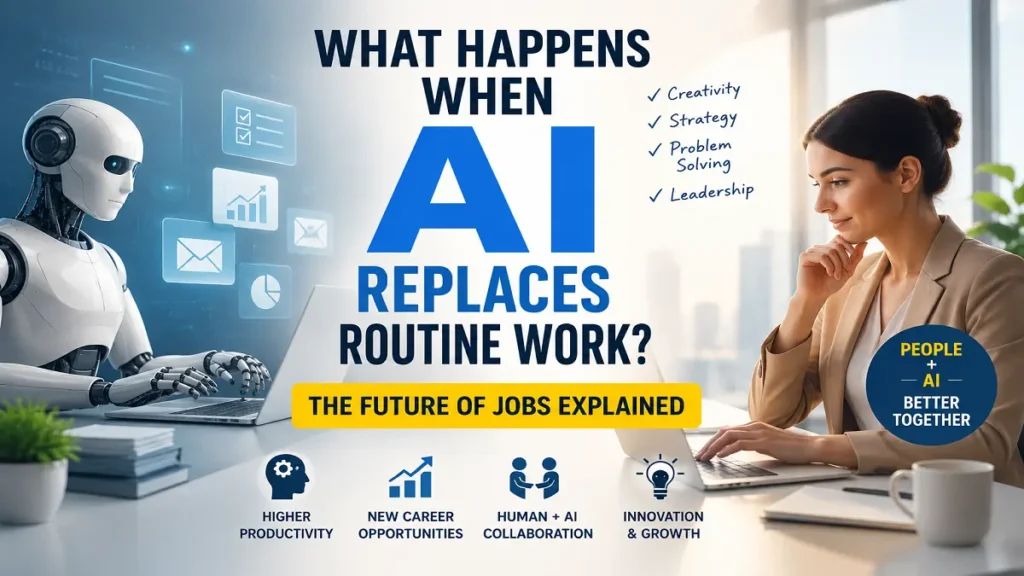
AI Is Changing Work, Not Eliminating It Entirely
Routine work includes repetitive, predictable tasks such as data entry, scheduling meetings, processing invoices, and basic customer support. These tasks follow clear rules, making them ideal for AI-powered tools.
Businesses are adopting AI because it saves time, reduces errors, and allows employees to focus on work that requires creativity, problem-solving, and human interaction. Instead of replacing every employee, AI often becomes a digital assistant that handles repetitive responsibilities.
For many organizations, the goal is not fewer workers but more productive teams.
Employees Can Focus on Higher-Value Work
One of AI’s biggest advantages is that it frees people from repetitive activities. Imagine spending hours sorting emails every day. An AI assistant can organize your inbox automatically, allowing you to spend more time on strategic planning, client communication, or creative projects.
Professionals in marketing, finance, healthcare, education, and software development are already using AI to speed up routine tasks while improving overall productivity.
The result is often better work rather than simply faster work.
New Careers Are Emerging
Every major technological revolution has created new jobs while changing existing ones. AI is following the same pattern.
Demand is growing for professionals who can work alongside AI, including:
- AI specialists
- Prompt engineers
- Data analysts
- AI ethics consultants
- Automation experts
- Cybersecurity professionals
- Digital transformation managers
Many traditional roles are also evolving. Teachers use AI to personalize learning, doctors use it to support diagnosis, and designers use it to generate creative ideas more quickly.
Learning how to collaborate with AI is becoming an increasingly valuable career skill.
Businesses Become More Competitive
Small businesses now have access to tools that were once available only to large corporations. AI can automate bookkeeping, customer support, content creation, scheduling, and inventory management at a fraction of the previous cost.
This allows entrepreneurs to spend more time growing their businesses instead of handling repetitive administrative work.
As AI becomes more affordable, even startups can compete with larger companies by operating more efficiently.
Challenges Cannot Be Ignored
While AI offers many benefits, it also creates real challenges.
Some routine jobs may disappear or require fewer workers. Employees whose responsibilities consist mostly of repetitive tasks may need to learn new skills to remain competitive.
There are also concerns about privacy, misinformation, bias in AI systems, and responsible decision-making. Governments, businesses, and technology companies must work together to ensure AI is developed and used ethically.
The future of work depends not only on technology but also on thoughtful policies and continuous education.
Lifelong Learning Becomes Essential
Perhaps the biggest change AI brings is the growing importance of continuous learning.
Workers who regularly improve their digital skills will have a significant advantage. Fortunately, learning AI no longer requires a computer science degree. Many online platforms now offer beginner-friendly courses on AI tools, automation, data analysis, and digital productivity.
People who combine technical knowledge with communication, leadership, creativity, and emotional intelligence are likely to remain highly valuable in the workplace.
Human Skills Become Even More Important
AI can process information quickly, but it cannot fully replace uniquely human abilities.
Creativity, empathy, leadership, negotiation, critical thinking, and ethical judgment remain difficult for machines to replicate. Companies increasingly value employees who can combine these human strengths with AI-powered tools.
Rather than competing against AI, successful professionals will learn to use it as a partner.
The Future Is Human Plus AI
The workplace of tomorrow is unlikely to be powered by humans alone or AI alone. Instead, the most successful organizations will combine the speed of artificial intelligence with human creativity and decision-making.
Routine work will continue to become more automated, but that creates opportunities for people to focus on innovation, relationships, and solving complex problems.
The future belongs to those who embrace change, keep learning, and understand how to work alongside intelligent technology. AI is not simply replacing routine work-it is redefining how work gets done, creating a future where humans and machines can achieve more together.