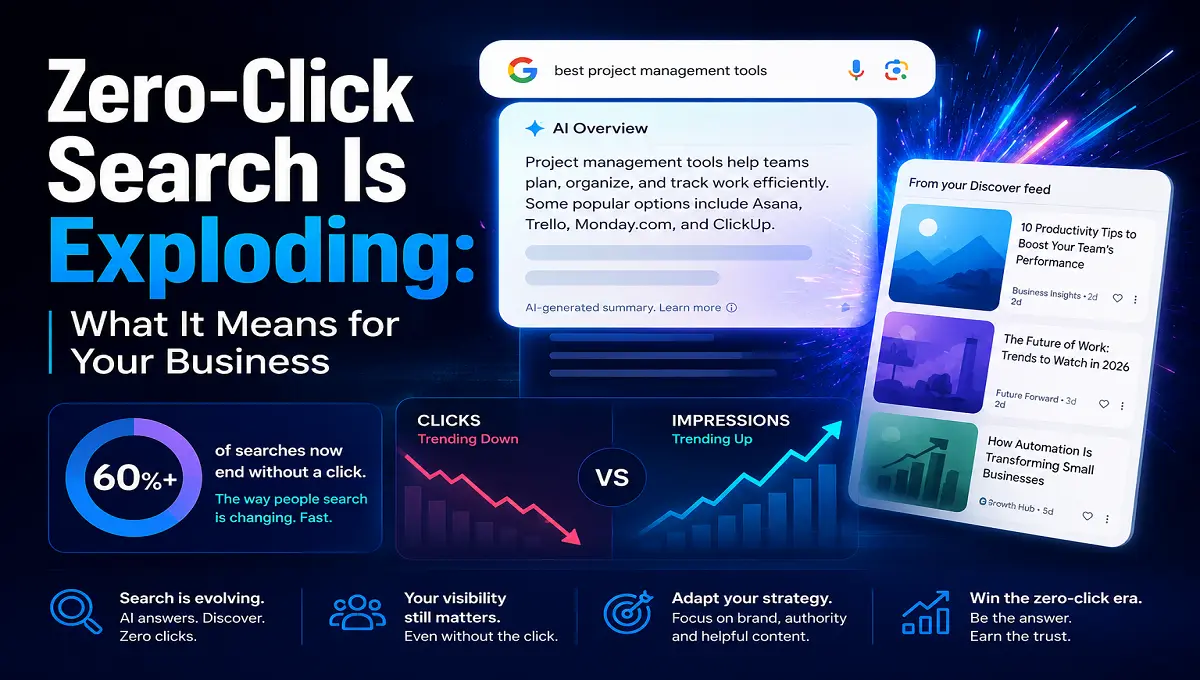

In 2026, one of the biggest shifts in digital marketing is happening quietly — and it’s changing how websites get traffic forever.
It’s called Zero-Click Search.
Users search on Google, get the answer instantly, and never click a website.
No visit.
No pageview.
No traditional SEO win.
For businesses that rely on organic traffic, this shift is massive. But for smart brands, it’s also a huge opportunity.
Here’s what zero-click search really means, why it’s growing so fast, and how your business can stay visible in the AI-first search era.
What Is Zero-Click Search?
Zero-click search happens when users get the information they need directly on the search results page without clicking any website.
Examples include:
- Google AI Overviews
- Featured snippets
- Knowledge panels
- Instant answers
- Maps results
- “People Also Ask” sections
- AI-generated summaries
A user searches:
“Best SEO strategy for small business”
Google now provides a full AI-generated answer instantly.
The user may never visit a blog post.
That’s zero-click behavior.
Why Zero-Click Search Is Growing Fast
Several major changes are driving this trend:
1. AI Search Is Replacing Traditional Search
Google’s AI Overviews are now answering millions of searches directly.
Instead of showing 10 blue links, search engines now summarize content from multiple websites into one AI response.
This reduces the need for users to click.
2. Users Want Faster Answers
People no longer want to open 5 websites to find one answer.
They want:
- Quick summaries
- Instant recommendations
- Short explanations
- Visual answers
- Voice-search responses
Zero-click search delivers exactly that.
3. Mobile Search Behavior Changed
Most searches now happen on mobile devices.
Users scroll quickly and often stop after the first visible answer.
If Google answers the query instantly, clicks disappear.
The Big Problem for Businesses
Many websites are losing traffic even while rankings remain stable.
That means:
- Your article may rank #1
- Your impressions may increase
- But clicks still drop
Why?
Because Google is using your content to answer users directly.
This is already happening across industries:
- SEO
- Finance
- Health
- Travel
- Technology
- E-commerce
- Education
Businesses depending only on organic traffic are seeing major visibility declines.
Google Discover Is Becoming More Important
As traditional search clicks decline, platforms like Google Discover are becoming critical traffic sources.
Discover works differently:
- It pushes content to users
- It favors engaging headlines
- It rewards authority and freshness
- It relies heavily on user interest signals
That’s why publishers and brands are shifting toward:
- Trend-driven content
- Strong visuals
- Emotional headlines
- Topical authority
- Brand recognition
In 2026, visibility matters more than rankings.
What Smart Businesses Are Doing Differently
The smartest brands are adapting instead of fighting AI search.
Here’s how.
1. Building Brand Authority
When users recognize your brand, they search for you directly.
Branded searches are becoming more valuable than generic keyword traffic.
Businesses are investing in:
- Personal branding
- Thought leadership
- Social media visibility
- Video content
- Email audiences
- Communities
The future belongs to recognizable brands — not anonymous websites.
2. Optimizing for AI Search
Traditional SEO is no longer enough.
Modern content must be optimized for:
- AI Overviews
- Conversational queries
- Semantic relevance
- Entity-based search
- User intent
- EEAT signals
Content that is structured clearly is more likely to appear inside AI-generated answers.
3. Creating “Experience Content”
AI can summarize facts.
But it struggles to replace:
- Real experiences
- Original opinions
- Case studies
- Personal insights
- Data-backed research
- Behind-the-scenes content
That’s why authentic content performs better in 2026.
Generic AI-written articles are becoming invisible.
4. Diversifying Traffic Sources
Depending only on Google traffic is now risky.
Modern businesses are growing through:
- Google Discover
- YouTube
- TikTok
- Newsletters
- Communities
- Push notifications
The goal is simple:
Own your audience instead of renting it from search engines.
How to Survive the Zero-Click Era
Here are practical strategies businesses should follow right now.
Focus on Topics, Not Just Keywords
Instead of targeting one keyword, build topical authority around an entire niche.
Search engines trust comprehensive expertise more than isolated articles.
Improve Content Quality
Thin content no longer works.
Create:
- Detailed guides
- Original research
- Expert opinions
- Visual content
- Updated statistics
- Interactive experiences
Quality is now a ranking factor and a visibility factor.
Use Strong Headlines
Google Discover and AI-driven feeds rely heavily on click psychology.
Good headlines increase visibility dramatically.
Examples:
- “Why Most SEO Strategies Fail in 2026”
- “The Hidden Reason Your Website Traffic Is Dropping”
- “Google’s AI Search Update Is Changing Everything”
Optimize for Entities
Search engines now understand entities more than exact-match keywords.
Your business should build relevance around:
- Your brand
- Industry expertise
- Authors
- Services
- Locations
- Topics
Entity SEO is becoming the future of search optimization.
Is SEO Dead?
No — but SEO is evolving rapidly.
Old SEO focused on rankings.
Modern SEO focuses on:
- Visibility
- Authority
- Brand trust
- User engagement
- Multi-platform presence
- AI discoverability
Clicks may decline, but influence is increasing.
Businesses that adapt early will dominate the next generation of search.
Final Thoughts
Zero-click search is not a temporary trend.
It’s the new reality of the internet.
Google, AI assistants, and modern search engines are changing how users consume information.
Businesses that continue using outdated SEO tactics will struggle.
But brands that focus on authority, trust, high-quality content, and audience building will continue to grow — even in a world where users click less.
The future of search is no longer just about ranking.
It’s about becoming the source AI trusts and users remember.
Discover more from
Subscribe to get the latest posts sent to your email.
