
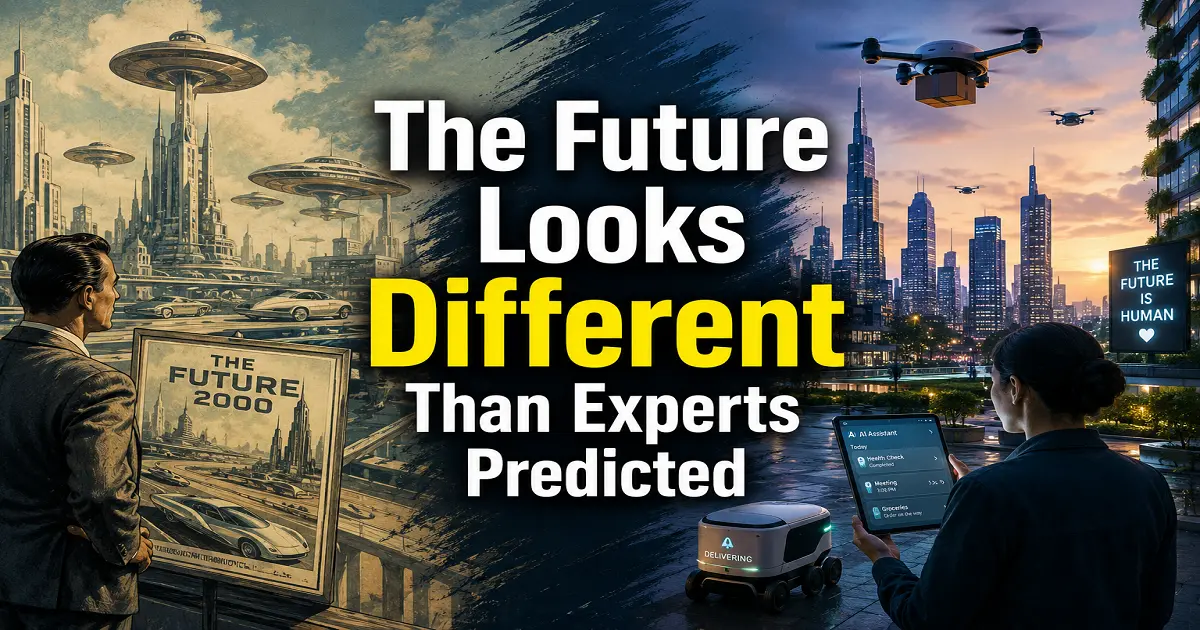

Remember when we were all supposed to have flying cars by now? Or when the internet was dismissed as a passing fad? Predicting the future is one of humanity’s favorite pastimes and one of its most consistent failures.
It’s not that experts are bad at their jobs. It’s that the future doesn’t move in straight lines. It zigzags, stalls, and occasionally sprints past every projection on the chart. Here’s a look at why our predictions keep missing the mark, and what that means for how we should think about tomorrow.
The Classic Misses
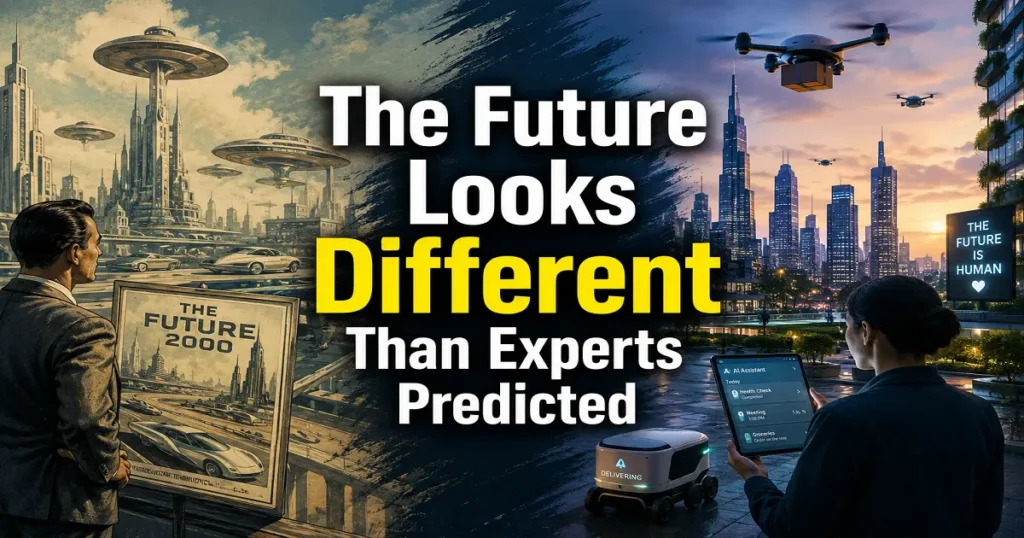
Some forecasting failures have become legendary. In the 1950s, futurists imagined a world of flying cars, moon vacations, and robot maids by the year 2000. Instead, we got smartphones a technology almost nobody saw coming in that specific form, yet one that reshaped daily life more than any hover-car ever could.
Then there’s the “paperless office,” a phrase coined in 1975 that predicted computers would eliminate paper from workplaces within a couple of decades. Offices today still print constantly. Meanwhile, something nobody predicted remote work becoming the norm for millions arrived almost overnight, driven not by gradual technological progress but by a global health crisis.
Even tech insiders get blindsided. Early internet pioneers thought e-commerce might work for a narrow set of goods. Few imagined people would routinely buy groceries, cars, or houses without touching them first. And when smartphones launched, several major companies dismissed touchscreens as a gimmick that would never replace physical keyboards.
Why We Keep Getting It Wrong
There’s a pattern behind these misses. People tend to overestimate how fast change will happen in the short term; while underestimating how much things will transform over the long term. This is sometimes called Amara’s Law, and it explains a lot: self-driving cars felt “five years away” for over a decade, while artificial intelligence’s recent leaps caught even AI researchers off guard.
Predictions also tend to assume the future is just a faster, shinier version of the present. But real change is often sideways, not forward it comes from something entirely unexpected recombining with existing tools. Nobody predicted social media by extrapolating from newspapers. It emerged from an unlikely mix of personal computing, mobile networks, and human curiosity about each other’s lives.
There’s also a bias toward predicting things that sound exciting. Flying cars make for a better magazine cover than “widespread access to information via a pocket-sized device.” So, forecasts often skew toward the dramatic and away from the mundane-but-transformative.
What This Means Going Forward
None of this means predictions are useless it means they’re best treated as guesses worth stress-testing, not blueprints to bank on. The smartest approach isn’t trying to guess the exact shape of the future. It’s building in flexibility so that whatever direction things go, you’re not caught flat-footed.
That’s true for individuals thinking about careers and skills, and it’s true for companies making big bets on where technology is headed. The people and organizations who fare best usually aren’t the ones who guessed correctly they’re the ones who stayed adaptable when reality zigged instead of zagged.
So, the next time someone confidently declares what life will look like in 2040, it’s worth remembering: the experts who predicted 2020 were picturing flying cars. We got video calls, remote work, and AI chatbots instead. The future has a habit of surprising everyone including the people whose job it is to predict it.
Discover more from
Subscribe to get the latest posts sent to your email.
