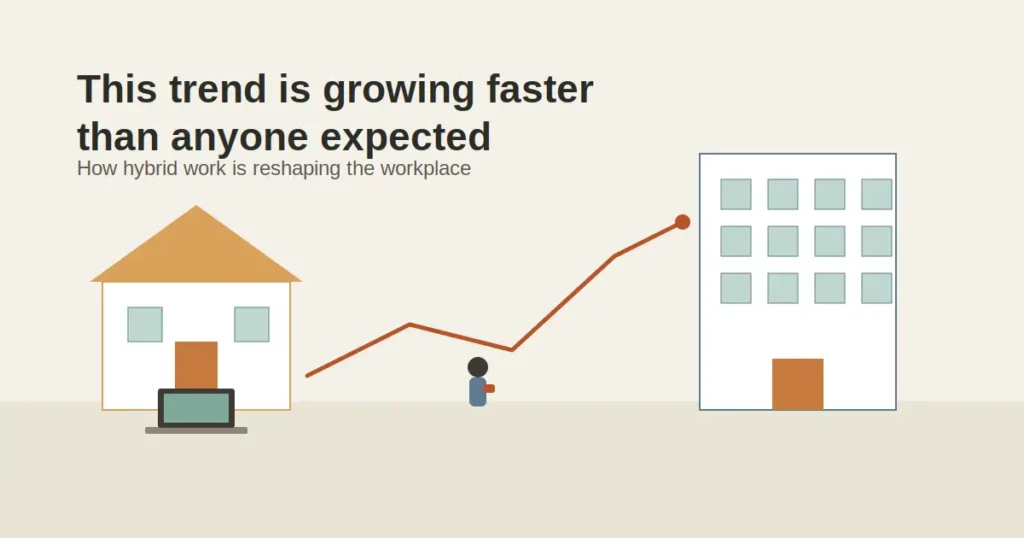
Remember when “return to office” was supposed to end remote work for good? That didn’t happen. Instead, hybrid work quietly became the new normal and it’s growing faster than almost anyone predicted.
The numbers tell the real story
Executives keep announcing office mandates. Employees keep… not fully complying. <cite index=”10-1,10-2″>Gallup data shows 52% of U.S. employees with remote-capable jobs now work hybrid, while another 26% work fully remote meaning roughly three out of four people who could go remote, do. </cite>
That’s not a fringe trend anymore. It’s the majority.
Why the office mandates aren’t working
Big companies love headlines about “everyone back to their desks.” But the data behind the scenes tells a different story. <cite index=”6-4″>Despite highly publicized return-to-office pushes from major employers, actual remote and hybrid work has held steady or even grown across the private sector. </cite>
Part of the reason: employees are voting with their feet. <cite index=”6-4″>A large share of workers say they’d quit if forced back into the office full-time, and most job seekers now list remote or hybrid options as a top priority in their search. </cite>
It’s not just about convenience anymore it’s about money
Here’s the part that surprises people. Working remotely isn’t just a lifestyle perk anymore it’s increasingly tied to pay. <cite index=”6-3″>On average, remote employees are earning more than their on-site counterparts, with some estimates showing a double-digit percentage gap once occupation and experience are factored in.</cite>
Certain fields are leading the charge. <cite index=”6-2″>Tech has the highest share of fully remote roles, with finance and insurance close behind, and specialized fields like AI, cybersecurity, cloud architecture, and data analytics are seeing the fastest growth in remote postings. </cite> Sales and business development roles are also expanding quickly in the remote space.
What employees actually want
If you ask workers directly, the preference is crystal clear. <cite index=”7-1,7-2″>Multiple 2026 studies converge on the same number: around 83% of workers in remote-capable roles say they prefer some form of hybrid arrangement over being fully in-office or fully remote. </cite> That consistency across different surveys is what makes this trend hard to dismiss as a fad.
Younger workers feel it most strongly, too flexible work arrangements are now a deciding factor for many people when choosing between job offers, not just a nice-to-have.
Why this trend keeps surprising people
The interesting twist is that this isn’t a story of remote work “winning” over office work. It’s more nuanced. Employees generally aren’t asking to never see a coworker again they still value in-person collaboration. What they’ve settled on is a blend: enough flexibility to skip the commute most days, with some in-office time built in for connection and teamwork.
That blend hybrid, not fully remote is exactly what’s driving the growth curve upward faster than forecasters expected a year or two ago.
The bottom line
Whether you’re job hunting, running a team, or just trying to understand why your friends keep talking about “hybrid schedules,” the takeaway is simple: this isn’t a temporary pandemic hangover. It’s a structural shift in how work gets done and it’s still accelerating.
Companies that fight it are finding themselves in a tougher spot for hiring and retention. Companies that lean into it are using it as a genuine competitive advantage. Either way, hybrid work looks less like a passing trend and more like the new baseline for the modern workplace.
This article discusses general workplace trends and is not intended as career or business advice specific to any individual situation.
Discover more from
Subscribe to get the latest posts sent to your email.