
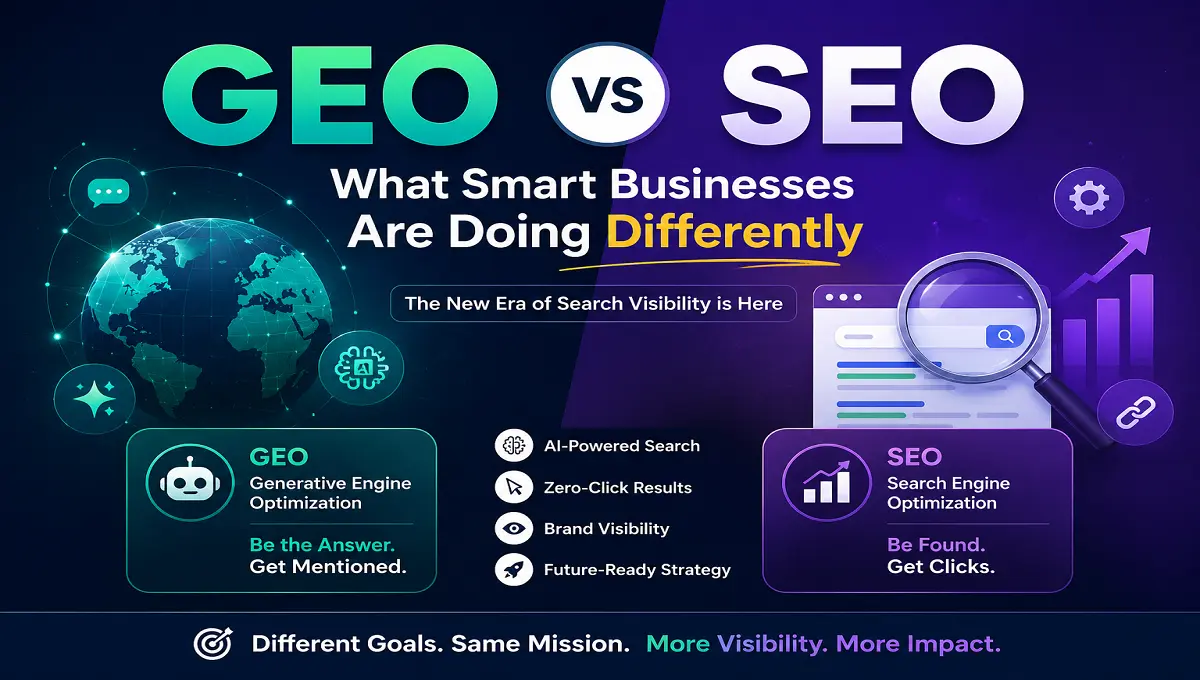

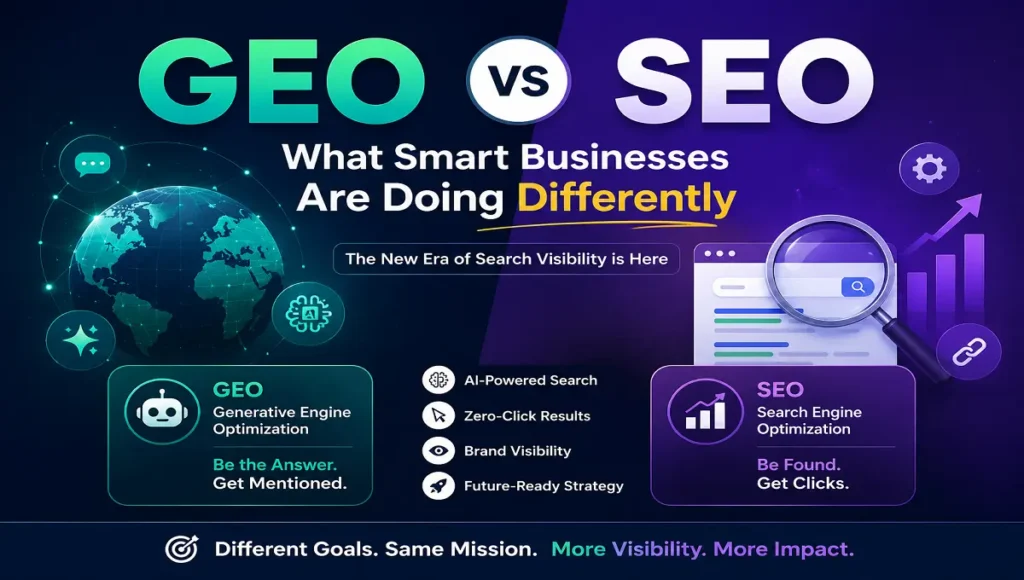
Search is changing faster than ever. For years, businesses focused on one goal: ranking on Google through traditional SEO. But now a new approach is emerging—GEO (Generative Engine Optimization)—driven by AI-powered search experiences and tools that summarize answers instead of just listing links.
Smart businesses are no longer choosing between SEO and GEO. They are learning how to combine both to stay visible in a world where search results are becoming answers, not pages.
What is SEO (Search Engine Optimization)?
SEO is the practice of optimizing your website so it ranks higher on search engines like Google.
It focuses on improving visibility in traditional search results (SERPs) through:
- Keyword optimization
- Backlinks
- High-quality content
- Technical SEO (site speed, mobile-friendliness, indexing)
- User experience signals
The goal of SEO is simple:
Get clicks from search results.
If your page ranks on page one, you get traffic. If it doesn’t, you’re mostly invisible.
What is GEO (Generative Engine Optimization)?
GEO is the process of optimizing content so it gets picked up, summarized, or cited by AI-powered search engines and assistants.
Instead of showing 10 blue links, AI systems generate direct answers using multiple sources.
Examples include:
- AI Overviews in search engines
- Chat-based search assistants
- Voice and generative AI tools
The goal of GEO is different:
Get mentioned or used inside AI-generated answers.
That means your content must be structured in a way AI systems can easily understand, trust, and extract.
Key Differences Between SEO and GEO
1. Ranking vs Being Referenced
- SEO: You compete for rankings on search results pages
- GEO: You compete to be included in AI-generated answers
With SEO, position matters.
With GEO, presence matters.
2. Keywords vs Meaning
- SEO: Focuses heavily on exact keywords
- GEO: Focuses on intent, context, and semantic meaning
AI systems don’t just match words—they interpret ideas.
3. Pages vs Information Blocks
- SEO: Long-form pages optimized for ranking
- GEO: Clear, structured information that can be extracted easily
Headings, summaries, FAQs, and bullet points matter more than ever.
4. Clicks vs Visibility
- SEO: Success = website traffic
- GEO: Success = brand visibility inside AI answers
Even without a click, your brand can still influence users.
What Smart Businesses Are Doing Differently
1. Writing for Humans AND Machines
Smart businesses are not stuffing keywords. Instead, they:
- Answer questions clearly
- Use structured sections
- Write conversationally
- Provide direct, useful insights
This makes content easier for both Google and AI systems to understand.
2. Building Topical Authority
Instead of random blog posts, they build clusters of content around a niche.
For example, a digital marketing agency might cover:
- SEO guides
- GEO strategies
- Content marketing
- Conversion optimization
This signals expertise and improves trust.
3. Optimizing for AI Extraction
GEO-friendly content includes:
- Clear headings (H2/H3 structure)
- Short summaries
- FAQ sections
- Definitions and comparisons
- Data-driven statements
This makes it easier for AI systems to pull accurate answers.
4. Strengthening Brand Signals
AI systems rely heavily on trust signals, such as:
- Consistent brand mentions
- Author credibility
- External references
- Strong online reputation
Brands that are recognizable are more likely to be included in AI responses.
5. Updating Content More Frequently
Old SEO content could still rank for years.
But GEO rewards freshness. Smart businesses:
- Update statistics regularly
- Refresh blog content
- Improve clarity over time
- Add new insights as trends change
Why GEO Doesn’t Replace SEO (Yet)
SEO is not dead. Far from it.
Traditional search still drives massive traffic, and ranking on Google remains essential for visibility.
But GEO is changing how users interact with search results. Instead of choosing one or the other, businesses now need a hybrid strategy:
- SEO brings traffic
- GEO brings presence in AI answers
Together, they create full-spectrum visibility.
The Future: Search Without Search Results
We are moving toward a future where users ask questions and get direct answers—without ever clicking a link.
In that world:
- SEO ensures your site exists in the index
- GEO ensures your brand is part of the answer
Businesses that ignore GEO risk becoming invisible, even if they still rank well.
Final Thoughts
The difference between GEO and SEO is not just technical—it’s strategic.
SEO is about being found.
GEO is about being included.
Smart businesses are already adapting by:
- Writing clearer content
- Structuring information better
- Building authority across topics
- Preparing for AI-driven discovery
The real winners in the next era of search won’t just rank—they’ll be referenced.
Discover more from
Subscribe to get the latest posts sent to your email.
