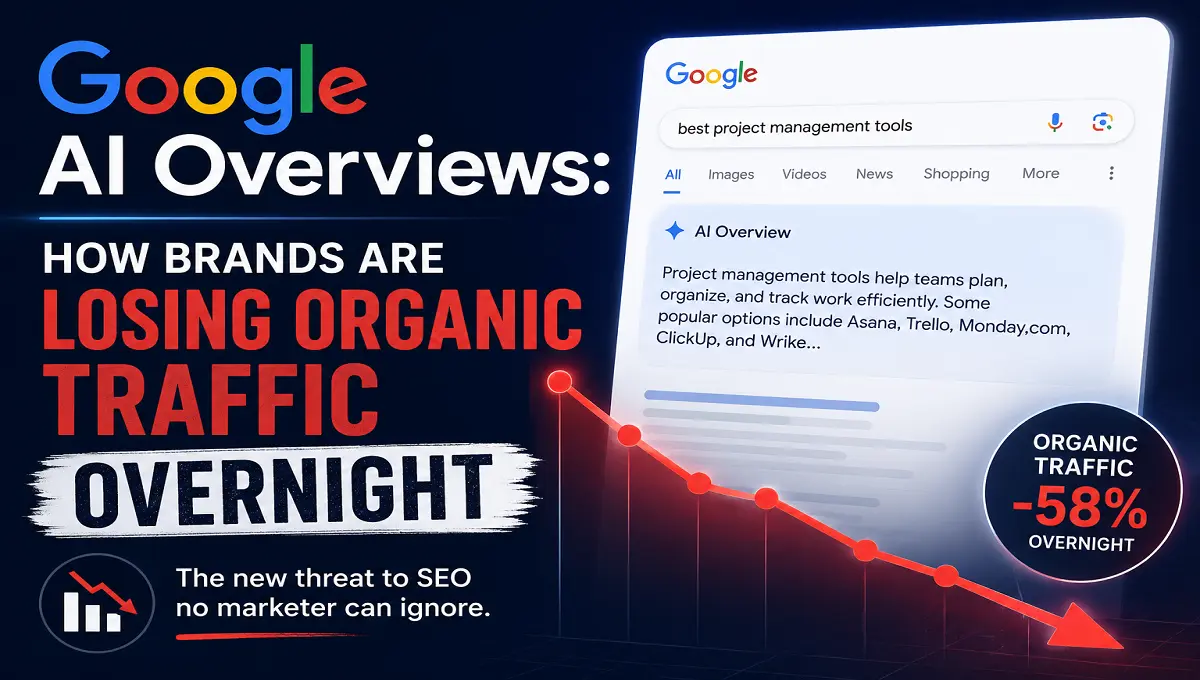

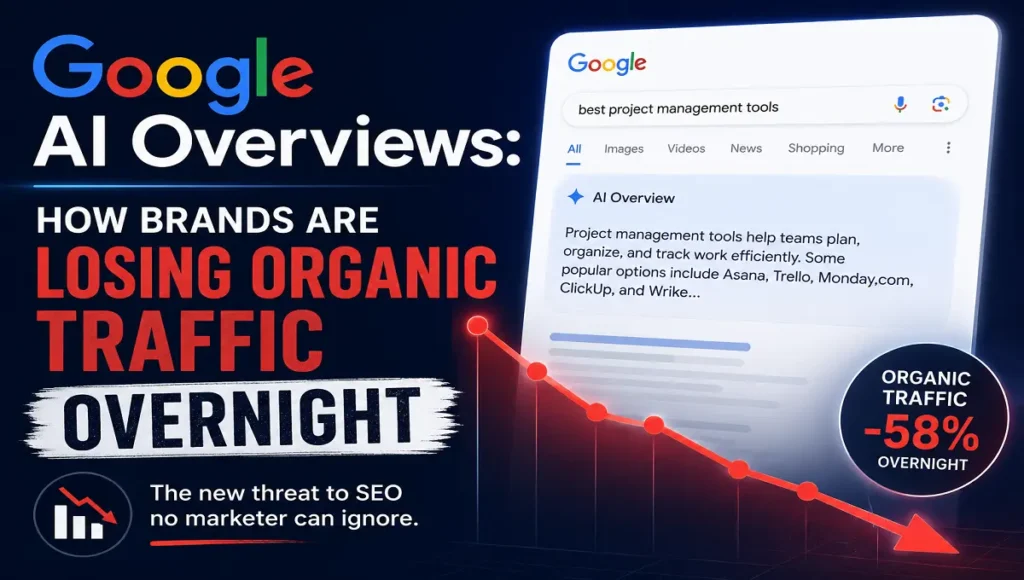
For years, brands fought for Google’s first page. Now, even ranking #1 is no longer enough.
Google’s AI Overviews have fundamentally changed search behavior in 2026. Instead of showing users a list of websites to click, Google increasingly answers questions directly inside search results using AI-generated summaries. The result? Millions of websites are seeing dramatic drops in organic traffic — even when rankings stay the same.
This isn’t a future trend. It’s already happening.
What Are Google AI Overviews?
Google AI Overviews are AI-generated answers displayed at the top of search results. They summarize information from multiple websites and present users with direct responses without requiring a click.


6
Originally launched as Search Generative Experience (SGE), the feature has rapidly expanded across informational and commercial searches. Some industry studies estimate AI Overviews now appear in nearly half of informational queries.
In simple terms:
- Users ask a question
- Google generates an instant AI summary
- Users get answers immediately
- Fewer people click websites
That’s the beginning of the “zero-click search” era.
Why Organic Traffic Is Falling So Fast
Many brands noticed something strange over the past year:
- Rankings remained stable
- Impressions stayed high
- But clicks suddenly collapsed
The reason is AI Overviews.
Research published in 2026 found that AI Overviews reduced organic clicks by 38% on queries where they appeared.
Other SEO studies report even larger CTR losses:
- 30–40% declines in organic traffic for affected keywords
- Up to 58–64% CTR reduction for top-ranking pages
- Informational searches are being hit hardest
The biggest issue?
Traditional SEO metrics can look “healthy” while actual business traffic disappears.
The Rise of Zero-Click Search
Google’s mission used to be sending users to websites.
Now the platform increasingly keeps users inside Google itself.


7
This creates a massive shift in search economics:
| Before AI Overviews | After AI Overviews |
|---|---|
| User clicks websites | User reads AI summary |
| Publishers earn traffic | Google keeps attention |
| SEO rewarded rankings | SEO rewarded citations |
| Top 3 rankings mattered | AI mentions matter more |
Several studies now show a sharp increase in searches ending without any click at all.
For publishers, bloggers, SaaS brands, affiliate websites, and media companies, this is becoming a major revenue problem.
Which Websites Are Losing the Most Traffic?
Not all websites are affected equally.
The biggest losers are sites targeting simple informational searches:
- “What is…”
- “How to…”
- “Best way to…”
- Definitions
- Beginner tutorials
- Basic comparison content
AI can summarize these instantly.
Industries seeing the largest impact include:
- Marketing blogs
- Health content
- Recipe websites
- Travel guides
- Legal information sites
- SaaS educational content
- Affiliate blogs
Meanwhile, some content types still perform relatively well:
- Original research
- First-party data
- Case studies
- Tools and calculators
- Community-driven content
- Unique opinions and expertise
Google’s AI still needs trustworthy source material.
Why Traditional SEO Is Breaking
Classic SEO focused heavily on rankings.
But AI Overviews changed the game.
Today, Google often pulls information from sites that don’t even rank in the top 10.
That means:
- Ranking alone no longer guarantees clicks
- Being cited by AI matters more
- Brand authority is becoming critical
- Structured data is increasingly important
The internet is moving from:
“Search Engine Optimization” → “Generative Engine Optimization”
Or GEO.
Brands now need content optimized for AI extraction, citation, and summarization — not just traditional rankings.
How Smart Brands Are Adapting
The brands surviving this shift are changing strategy fast.
Here’s what they’re doing differently:
1. Building Topical Authority
Instead of publishing random SEO articles, brands are building deep expertise clusters around specific subjects.
Google’s AI favors trusted authorities.
2. Creating Original Data
AI summaries rely heavily on unique statistics, studies, surveys, and proprietary insights.
If your content says the same thing as everyone else, AI can summarize it without sending traffic.
Unique data is harder to replace.
3. Optimizing for AI Citations
Brands are restructuring content for extraction:
- Clear headings
- Concise answers
- Schema markup
- FAQ sections
- Expert quotes
- Entity-based SEO
The goal is no longer just ranking.
It’s becoming a source AI systems trust and cite.
4. Investing in Brand Searches
Strong brands lose less traffic because users search for them directly.
When users type:
- “HubSpot SEO guide”
- “Ahrefs keyword research”
- “Semrush backlink tool”
AI Overviews have less power to intercept those clicks.
Brand demand is becoming an SEO moat.
5. Diversifying Traffic Sources
Relying entirely on Google organic traffic is becoming dangerous.
Smart brands are investing more heavily in:
- Email marketing
- Communities
- YouTube
- Podcasts
- Google Discover
- AI platform visibility
Some publishers are already seeing Discover traffic partially offset search declines.
The Hidden Opportunity Inside AI Overviews
There’s one important nuance many marketers miss:
Being featured inside AI Overviews can still drive visibility.
Some studies suggest cited brands receive higher-quality clicks and stronger authority signals.
In other words:
- Total clicks may decline
- But citation visibility still matters
- Trust and brand recognition can increase
The winners in 2026 won’t necessarily be the sites with the most traffic.
They’ll be the brands most visible across AI-driven search ecosystems.
What the Future of SEO Looks Like
SEO is not dead.
But the old version of SEO is.


7
The future belongs to brands that can:
- Become authoritative entities
- Publish unique insights
- Build recognizable brands
- Earn AI citations
- Create content AI cannot easily replace
Traffic strategies based purely on mass-produced informational articles are collapsing fast.
The internet is entering an era where visibility matters more than rankings alone.
And brands that fail to adapt may watch their organic traffic disappear almost overnight.
Final Thoughts
Google AI Overviews represent the biggest shift in search since mobile-first indexing.
The rules of organic traffic have changed:
- Rankings are less valuable
- Clicks are shrinking
- AI answers dominate SERPs
- Brand authority matters more than ever
For marketers, publishers, and businesses, the key question is no longer:
“How do we rank higher?”
It’s now:
“How do we become the source AI trusts?”
Because in 2026, that’s where the real visibility lives.
Discover more from
Subscribe to get the latest posts sent to your email.
