
Search is no longer limited to traditional search engines like Google. Today, users are increasingly getting answers from AI systems such as ChatGPT, Gemini, Claude, and AI-powered search engines that summarize information instead of just listing links.
This shift has created a new discipline: AI Search Optimization (often overlapping with GEO—Generative Engine Optimization). If your content isn’t optimized for AI systems, you risk becoming invisible—even if you rank well on Google.
In this guide, you’ll learn how to optimize your content for AI search engines and stay ahead of the competition.
What Are AI Search Engines?
AI search engines and assistants like:
- OpenAI (ChatGPT)
- Google (Gemini / AI Overviews)
don’t just show links. Instead, they:
- Read multiple sources
- Understand context
- Summarize answers
- Generate direct responses
This means your content must be structured for understanding, not just ranking.
SEO vs AI Optimization: What’s Different?
Traditional SEO focuses on ranking web pages. AI optimization focuses on being used in answers.
| SEO Focus | AI Search Focus |
|---|---|
| Keywords | Meaning & context |
| Rankings | Citations & mentions |
| Backlinks | Authority signals |
| Clicks | Visibility in answers |
To succeed today, you need both strategies working together.
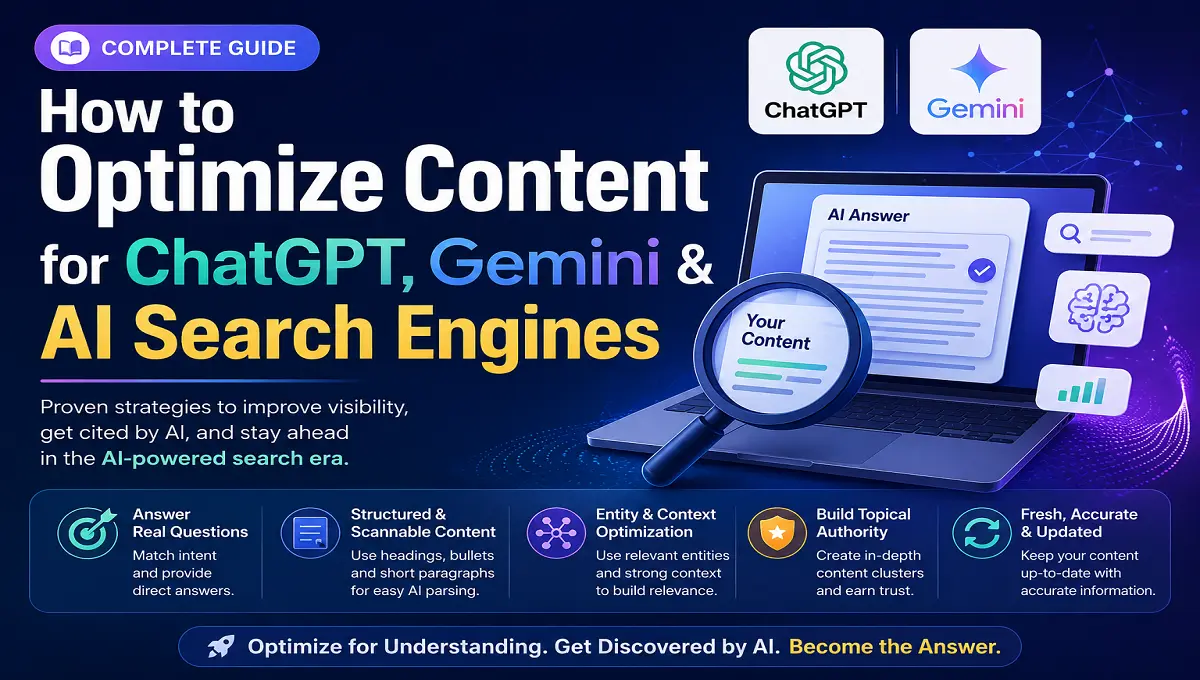
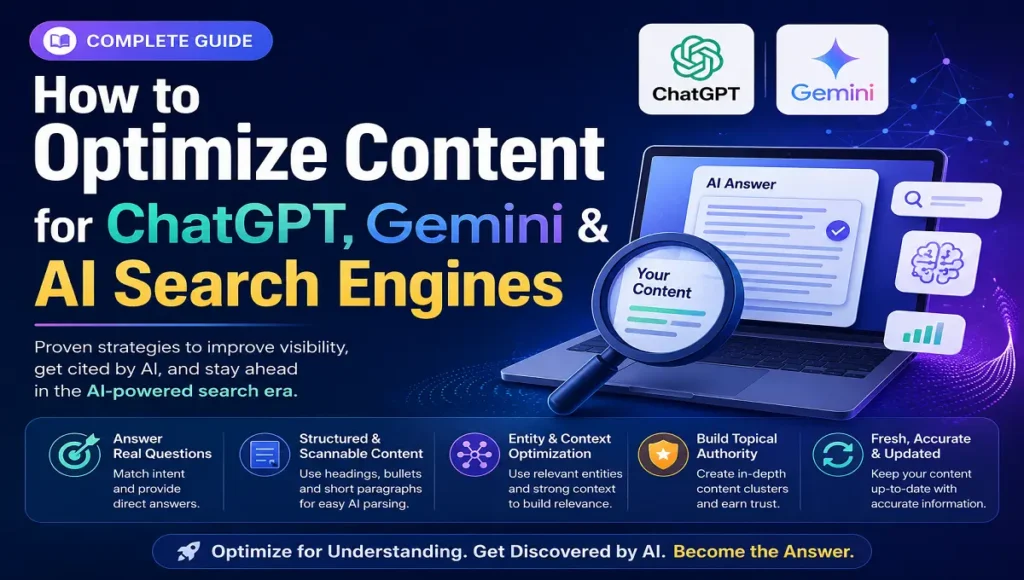
1. Write Content That Answers Questions Clearly
AI systems prefer content that directly answers user queries.
Instead of writing:
“Digital marketing is very important for businesses…”
Write:
“Digital marketing helps businesses attract customers through online channels like search engines, social media, and email marketing.”
Clear, direct answers increase your chances of being used in AI-generated responses.
2. Use Structured Formatting (Very Important)
AI models prefer well-structured content that is easy to parse.
Use:
- Headings (H2, H3)
- Bullet points
- Numbered lists
- Short paragraphs
- FAQs
Example:
What is AI SEO?
AI SEO is the process of optimizing content so it appears in AI-generated answers from tools like ChatGPT and Gemini.
3. Build Topical Authority
AI systems trust websites that show deep expertise in a subject.
Instead of writing random posts, build topic clusters like:
- SEO basics
- Advanced SEO strategies
- GEO / AI SEO
- Content marketing
- Keyword research
When your content covers a topic in depth, AI models are more likely to reference it.
4. Focus on Semantic Keywords (Not Just Exact Matches)
AI systems understand meaning, not just exact words.
Instead of repeating:
- “SEO optimization tips”
Use variations like:
- search engine ranking strategies
- website visibility improvement
- organic traffic growth techniques
This helps AI systems understand your content better.
5. Add Definitions, Summaries, and FAQs
AI tools love content that is easy to extract.
Include:
- Simple definitions
- TL;DR summaries
- FAQ sections
Example:
FAQ
Q: What is AI search optimization?
A: It is the process of optimizing content so it appears in AI-generated responses from tools like ChatGPT and Gemini.
6. Improve Brand Authority Signals
AI systems prefer trusted sources.
To improve authority:
- Get mentioned on reputable websites
- Build strong brand identity
- Maintain consistent content publishing
- Earn backlinks from relevant sites
The stronger your brand presence, the more likely AI will include you in answers.
7. Keep Content Updated and Relevant
AI models prioritize fresh and accurate information.
Regularly:
- Update statistics
- Refresh outdated sections
- Add new insights
- Improve clarity
Stale content loses visibility in AI-driven search environments.
8. Optimize for Conversational Queries
People now search like they talk:
Instead of:
- “SEO tools list”
They ask:
- “What are the best SEO tools for beginners?”
Write content that matches natural language queries.
9. Think Beyond Clicks: Optimize for Visibility
Traditional SEO goal:
👉 Get clicks
AI search goal:
👉 Get mentioned in answers
Even if users don’t click your website, your brand appearing in AI responses builds authority and awareness.
10. Combine SEO + AI Optimization Strategy
The winning formula is not replacing SEO—it’s combining both:
- SEO brings traffic from search engines
- AI optimization brings visibility in AI answers
Together, they create maximum digital reach.
Final Thoughts
AI search is reshaping how people discover information. Platforms like ChatGPT and Gemini are becoming primary sources of answers, not just tools.
To stay ahead, businesses must shift from keyword-only SEO to intent-driven, structured, and AI-friendly content creation.
The future of visibility is not just ranking on search engines—it’s being part of the answer itself.
Discover more from
Subscribe to get the latest posts sent to your email.
