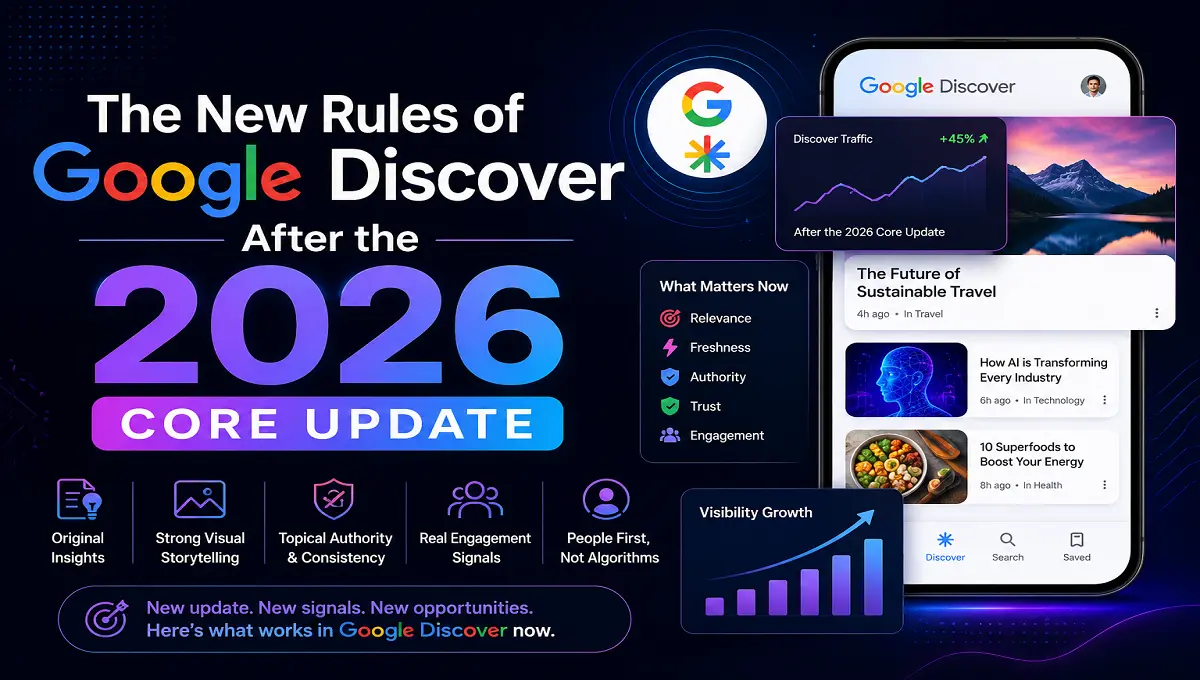

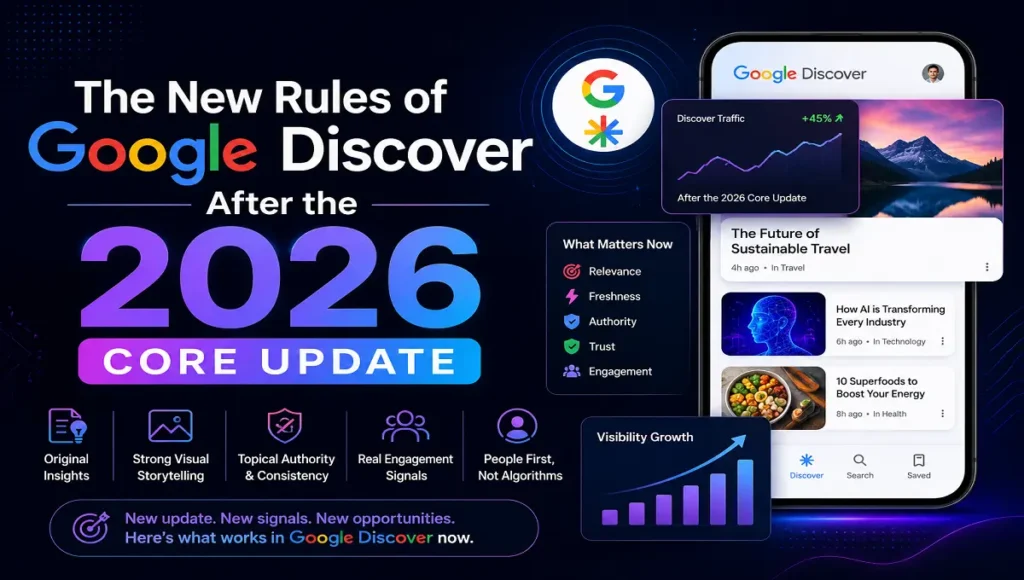
Google Discover has officially changed forever.
The February 2026 Discover Core Update was the first major Google update designed specifically for Discover — not traditional search rankings. For publishers, bloggers, SEO agencies, and brands that rely on Discover traffic, the rules are now completely different.
Many websites saw massive traffic swings overnight. Some publishers gained visibility, while others lost 70–90% of their Discover traffic within days. The reason? Google fundamentally changed how Discover decides which content deserves attention.
If your strategy still relies on clickbait headlines, generic AI content, or random trending topics, your Discover traffic is at risk.
Here’s what changed — and how smart publishers are adapting in 2026.
What Is Google Discover?


7
Google Discover is a personalized content feed shown inside:
- The Google app
- Chrome mobile homepage
- Android devices
Unlike Google Search, users do not type queries. Google recommends content based on:
- User interests
- Search behavior
- Engagement history
- Location
- Trending topics
- Content quality signals
This makes Discover more like TikTok or YouTube recommendations than traditional SEO.
The Biggest Changes in the 2026 Discover Core Update
1. Local Content Now Wins
Google now strongly prioritizes content from publishers located in the user’s country or region.
For example:
- US users see more US-based publishers
- UK users see more UK content
- Pakistani users increasingly see regional and local publishers
This means international sites trying to dominate foreign Discover feeds may lose visibility unless they build local relevance.
What Google Is Rewarding Now
- Country-specific websites
- Local expertise
- Regional trends
- Native-language content
- Local news and events
- Geo-targeted publishing
What This Means for Bloggers
If your website targets global audiences with generic content, you may struggle.
Instead, create:
- Local industry insights
- Country-specific guides
- Regional case studies
- Local trend coverage
Local relevance is now a ranking signal in Discover.
2. Clickbait Headlines Are Being Crushed


5
Google has officially reduced visibility for sensational headlines and misleading titles.
Headlines like:
- “You Won’t Believe What Happened”
- “This SEO Trick Changed Everything”
- “Doctors Hate This One Method”
are now far less effective in Discover.
Google is using stronger headline-to-content matching systems. If your title overpromises and the article underdelivers, Discover visibility drops.
The New Headline Formula
Winning headlines in 2026 are:
- Clear
- Specific
- Trustworthy
- Timely
- Benefit-driven
Example
❌ Bad:
“SEO Is Dead Forever”
✅ Better:
“Why Traditional SEO Traffic Is Declining in 2026”
The goal is curiosity without manipulation.
3. Topic Expertise Matters More Than Domain Authority
This may be the biggest shift of all.
Google now evaluates expertise topic-by-topic instead of relying mainly on overall website authority.
That means:
- A small niche blog can outrank major media websites
- Focused expertise beats broad publishing
- Consistency matters more than random trending posts
Example
A dedicated fitness blog can outperform a giant news site on workout content because Google sees deeper topical authority.
What Google Wants
Google wants websites that:
- Consistently publish within a niche
- Demonstrate real expertise
- Build content depth over time
- Create original insights
Random multi-topic publishing is becoming less effective.
4. Original Content Is Becoming Essential


5
Google Discover is aggressively filtering:
- Rewritten articles
- AI-spun content
- Duplicate news summaries
- Thin affiliate pages
The update heavily rewards:
- First-hand experience
- Original reporting
- Unique opinions
- Data-backed insights
- Real examples and screenshots
Publishers relying entirely on AI-generated filler content are seeing major Discover losses.
The New Content Standard
To perform well:
- Add expert commentary
- Include original images
- Share personal insights
- Publish unique statistics
- Update content regularly
AI can help production — but originality now matters more than scale.
5. User Engagement Signals Matter More
Discover is behavior-driven.
Google watches:
- CTR (click-through rate)
- Time on page
- Scroll depth
- Bounce behavior
- Return visits
- Topic engagement history
If users quickly leave your article, your Discover visibility may decline.
How to Improve Engagement
- Use stronger introductions
- Improve page speed
- Add visuals throughout content
- Use mobile-first formatting
- Keep paragraphs short
- Make headlines match article intent
6. Visual Content Is Now Critical


6
Google Discover is highly visual.
Large, high-quality images dramatically improve click-through rates. Many SEO professionals reporting Discover wins after the update also noticed strong image optimization patterns.
Best Practices
- Use featured images at least 1200px wide
- Avoid stock-photo overload
- Create custom graphics
- Optimize mobile loading speed
- Use compelling thumbnails
Your image often determines whether users click.
How to Win on Google Discover in 2026
Focus on One Strong Niche
Instead of publishing everything:
- Build topical authority
- Stay consistent
- Create content clusters
Google wants specialists.
Publish Faster on Trends
Discover loves:
- Fresh topics
- Trending discussions
- Emerging news
- Timely insights
But quality still matters.
The ideal strategy:
- Publish quickly
- Add expert analysis
- Provide unique value
Build Brand Trust
Google increasingly rewards recognizable brands and trusted authors.
Improve:
- Author bios
- About pages
- Social proof
- EEAT signals
- Real company information
Trust is now part of Discover visibility.
Optimize for Mobile First
Most Discover traffic comes from mobile devices.
Your website must:
- Load fast
- Look clean on mobile
- Avoid intrusive ads
- Use readable typography
- Support Core Web Vitals
The Future of Google Discover


6
The 2026 update proves Google Discover is evolving into a highly personalized AI-driven recommendation engine.
Instead of rewarding:
- Keyword stuffing
- Clickbait
- Mass publishing
Google now rewards:
- Expertise
- Originality
- Relevance
- Trust
- User satisfaction
Discover traffic will become harder to manipulate and more dependent on real audience value.
Publishers that adapt early will dominate the next era of organic traffic.
Final Thoughts
The old Discover strategy is dying.
In 2026, success on Google Discover requires:
- Niche authority
- Honest headlines
- Original content
- Local relevance
- Strong engagement
- Mobile-first experiences
Publishers who focus on quality, expertise, and trust will continue growing — while low-value content sites disappear from the feed.
Google Discover is no longer about gaming algorithms.
Discover more from
Subscribe to get the latest posts sent to your email.
